Archives for category: General

Once again PARP:PS is represented at the Computer Applications and Quantitative Methods in Archaeology conference, this year in Perth. This is the third presentation of our paperless work at this conference and for a bizarre set of reasons, the third one that I will miss. This year we are being represented by Leigh Lieberman and Gregory Tucker in a paper written with me and Kevin Dicus called Beyond Tablet Computers as a Tool for Data Collection: Three Seasons of Processing and Curating Digital Date in a Paperless World. This paper will be presented on Thursday in session S6. I will post a draft of this paper in a separate post.

CAA 2103 has a number of sessions of interest for paperless archaeology including an entire session (S38) on Mobile Applications in Cultural Heritage and Archaeology. Tom Sapienza has a paper on his work in Western Australia in session S18 in a paper titled “On a Digital Workflow for Remote CHM: Six Years of Paperless Fieldwork in the Pilbara, Western Australia.” There is a paper on using REVEAL, software developed by Brown, Univ of North Carolina, and the Institute for the Visualization of History, titled “Old problems and new challenges in archaeological sites data management. The REVEAL experience at Ammaia (Portugal)” (S15). There is also an interesting sounding paper on the problems encountered in the quest for paperless recording in S2: “Android GIS – not ready for prime time.”

Of particular interest to me is the session S1, which is focused on how several teams are using various technologies to record Rock Art in both Australia and the US.

Of interest in matters of archiving, the ADS has a paper in session S37.3 “The ADS, digital archives and economic impact.” Ohio State and Michigan State are talking about “The Archaeological Resource Cataloging System: A Better Way of Working with Digital Archives” in session S32.

Eric Kansa from Open Context will be delivering a keynote talk on “Reimagining Archaeological Publication for the 21st Century,” concerning the struggle between Open Access and intellectual property laws.

All in all it sounds like an excellent conference and I wish that I was there.
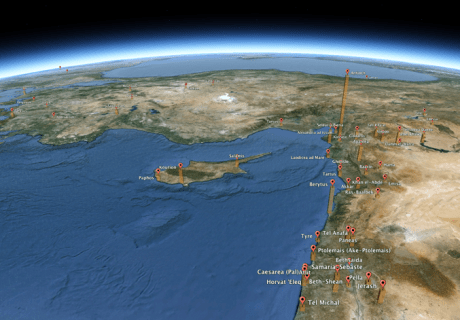
googleearthbarcharts

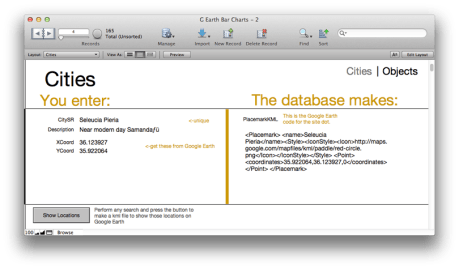
One of our graduate students here at UC is investigating the movement of artifacts from the origin to archaeological find spot. She had been gathering her data in a FileMaker Pro database and wanted to be able to visualize the quantity of material either sourced or found in various cities. Since she already had a data table of cities with coordinates gathered from Google Earth, I decided to see if I could get FileMaker to talk directly to Google Earth. This database is the result.

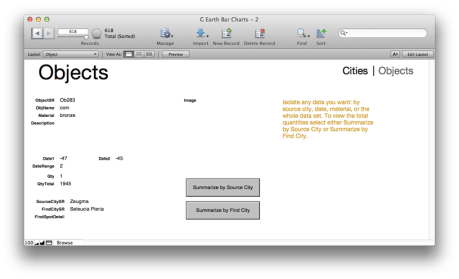
The database consists of a table of cities, and a table of objects.

cities

objects

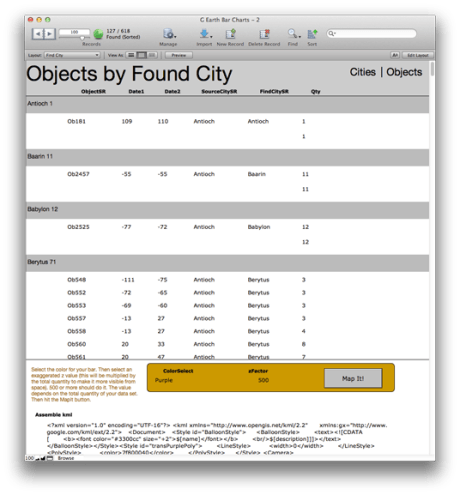
The objects have a field for Source City and a field for Find City. They also have a quantity. You can limit your query to anything: source city, find city, material, object type, dates, etc. You can view the summary results by either source or find city and export the result into a kml file that can be viewed in Google Earth.

This will work on an iPad as well, with FileMaker Go and Google Earth, but you will need to use an intermediary file manager (such as GoodReader) to change the extension from .txt to .kml.

summary

Read the rest of this entry »

Having access to the PARP:PS database was invaluable when developing the Sangro Valley Project’s database and paperless workflow (see my first post for an overview and this post for more background information). In that sprit of cooperation I have made available an unlocked version of the database originally developed for the SVP. The database – which we have dubbed “Cera,” the Latin word for a wax writing tablet – can be downloaded here (see licensing below and in the ReadMe file that comes with the database). You can no longer download a demo of FileMaker Pro 11 directly from FileMaker. The file will work with the demo of FileMaker Pro 12, but it will need to be converted first.

Read the rest of this entry »

#hth2012 is the hashtag for the High Tech Heritage 2012 conference currently being held at UMass Amherst. Lots of good tweets coming from that conference. I especially like Eric Kansa’s summary of Frank McManamon’s Plenery talk.

There is an upcoming deadline of 15 May to apply for grants from tDAR to help you get your data into tDAR.

Awards of up to $7,000 are available for cultural resource management (CRM) firms, public agencies, individual researchers, universities, colleges and other organizations to support the direct cost of contribution of digital archaeological content (e.g. documents, data sets, images, etc.) to tDAR, Digital Antiquity’s international digital repository.  Proposals that demonstrate geographical or thematic coherence, a breadth of audience interest, integration of resource management and scientific research across archaeological projects, and those that contribute different types of digital files related to the same archaeological investigations will be considered favorably.

While tDAR is overwhelmingly focused on North American archaeology (by design) there are a few datasets of interest to those who work in Europe and the Mediterranean.